
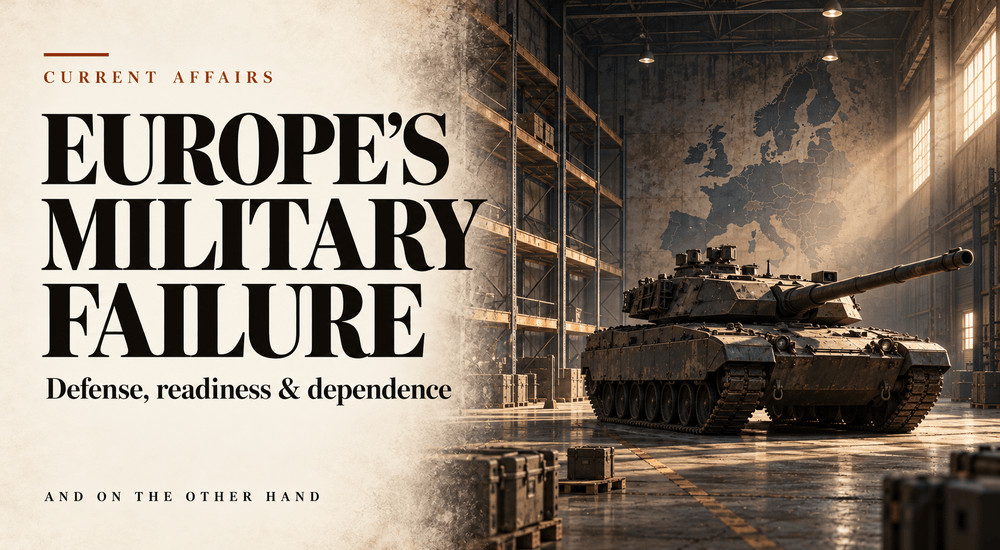
Europe’s military failure did not happen overnight, and it did not go unnoticed. In September 2018, while giving a speech at the United Nations General Assembly, President Trump pointed to the German delegation and noted their reliance on Russian energy. Their response was to laugh, and afterwards to take the President to task for making such an outrageous statement.
At the same time, President Trump openly questioned why the U.S. was providing at least seventy-five percent of the budget for NATO while only three countries were meeting their promised military contribution of two percent of GDP. This article looks at how Europe arrived at this point, why Western Europe in particular failed its most basic duty, and what it means for NATO and the United States.
Trump’s Warning on Russian Energy and NATO Spending
The two percent figure was not invented by Washington. At the 2014 NATO summit in Wales, allied leaders agreed that members spending below that level would aim to move toward two percent of GDP on defense within a decade. Trump’s point was that most European members were not meeting that commitment. His warning about Russian energy, meanwhile, was treated as a joke.
European Fears of a Second Trump Term
Fast forward to 2023. With Trump holding a commanding lead in the Republican race for the presidential nomination, reports from Europe focused on the danger of a Trump presidency.
Will Trump pull the U.S. from NATO? Will he cut U.S. aid to Ukraine?
Magazines and talk shows in the U.S. spent their entire time proclaiming the dangers of a second term for Trump.
Seventy-Five Years Under the American Security Umbrella
The reality is that the Europeans and others should thank Trump for his hard-line stance, as it forced the Europeans to face the reality of their failures with their own militaries.
The list of failures is long:
Minimal maintenance of equipment
Discarding the technologies needed to supply their own militaries
Having to rent tanks from a neighboring nation, because the borrowing nation does not have a single tank of its own
The Europeans have spent over seventy-five years living under the security umbrella provided, at huge expense, by the American public. Their slow response to Trump’s prodding at least gave them a small start when their world collapsed under the cut-off of Russian energy and the third invasion of Ukraine.
Europe’s Military Failure and Poland’s Rise
The linked Wall Street Journal article, “Alarm Grows Over Weakened Militaries and Empty Arsenals in Europe”, outlines the failure of the Western European states to meet their primary responsibility to their citizens: to ensure national security.
Central and Eastern European states, which suffered under half a century of Soviet brutality, applauded Trump because they had experienced the nightmare of Communism. At the same time, Western European states built up welfare systems that discouraged work and cemented in place programs which are not sustainable.
In fact, at the current pace, it will be Poland that provides the protection for a weak Germany for the foreseeable future.
The Future of NATO and America’s Role
Will Trump still question the need for the U.S. to stay in NATO? No one knows for sure. But if the Europeans, especially the Western nations, do not break their word again and instead fulfill their promises, then perhaps Trump will see that the U.S. is not involved in another of our terrible foreign policy deals.
The addition of responsible states such as Finland, which joined NATO in 2023, and Sweden, which joined in 2024, will help to keep the Western European states in line during the struggles ahead, not only with Russia, but with China and Iran.
Frequently Asked Questions
What is meant by Europe’s military failure?
It refers to the long decline of many European militaries, including poorly maintained equipment, shrinking defense industries, and empty arsenals, after decades of relying on the United States for security.
What is the NATO two percent defense spending target?
At the 2014 Wales summit, NATO members agreed that those spending below two percent of GDP on defense would aim to move toward that level within a decade.
What did Trump say about Germany and Russian energy?
In his September 2018 speech at the United Nations, Trump warned that Germany was becoming dependent on Russian energy. Members of the German delegation were seen laughing at the remark.
Why do Central and Eastern European states view NATO differently?
They suffered under half a century of Soviet brutality and experienced the nightmare of Communism firsthand, which is why they applauded Trump’s pressure on Europe to meet its defense commitments.
When did Finland and Sweden join NATO?
Finland joined NATO in April 2023, and Sweden joined in March 2024, bringing the alliance to 32 members.