

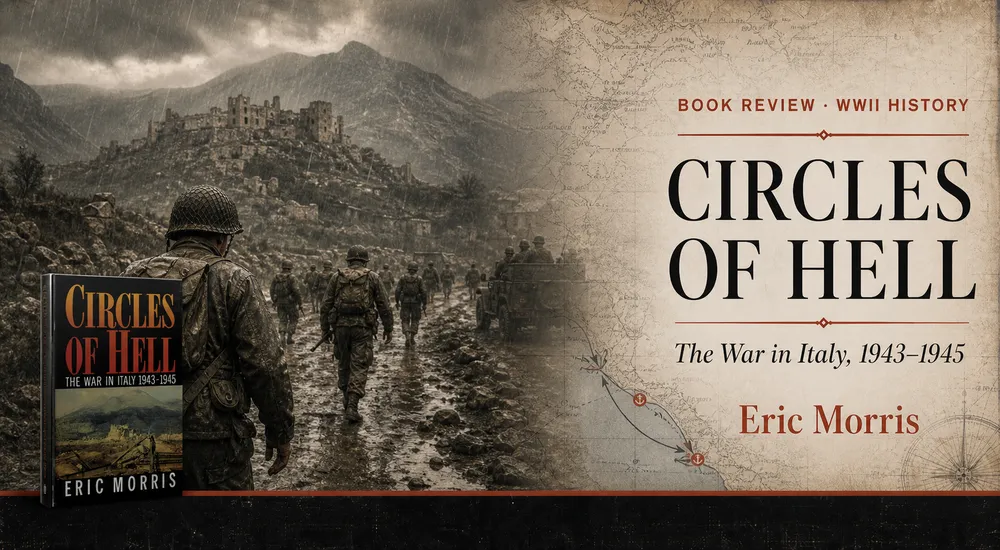
Eric Morris’s Circles of Hell: The War in Italy, 1943–45 examines one of the most difficult and often overlooked campaigns of the Second World War.
The Allied campaign in Italy was shaped by competing military objectives, political considerations, difficult terrain, leadership disputes, and the determination of German forces to defend the Italian peninsula.
The campaign that initially appeared to offer an opportunity for a relatively quick Allied advance instead developed into a prolonged and costly series of battles.
Churchill’s Vision for the Italian Campaign
Winston Churchill viewed Italy as the potential “soft underbelly” of Hitler’s Europe.
He believed that an Allied campaign in Italy could accomplish more than simply forcing Italy out of the war. He also hoped that Allied forces could potentially use Italy as a route toward the Balkans and position themselves ahead of the advancing Soviet Army.
This strategic vision differed from the views of many Allied military planners.
The Military Challenges of Fighting in Italy
For Allied generals, Italy presented significant geographical and tactical problems.
The mountainous terrain was poorly suited to the rapid armored warfare that had become an important feature of the war. Instead of allowing Allied forces to exploit their advantages in mobility and material superiority, the Italian landscape frequently favored defensive operations.
Rivers, mountains, narrow valleys, and fortified defensive positions created enormous obstacles for advancing Allied troops.
One potential advantage was that Allied forces could establish additional bases from which aircraft could attack targets in Germany.
Salerno, Anzio, and the Expansion of Allied Objectives
The original objectives of the Italian campaign gradually expanded.
Political and military considerations made the liberation of Rome an increasingly important goal. The symbolic significance of Rome and the Vatican created additional pressure for Allied commanders to advance.
Operations at Salerno and Anzio were intended in part to outflank German defensive positions and create opportunities for a faster advance.
Instead, German forces reinforced the Italian theater and demonstrated that they could make the Allied advance extremely costly.
The result was a campaign that became far more difficult than some Allied planners had initially anticipated.
Generals, Reputation, and Military Leadership
The Italian campaign also affected the reputations of senior Allied commanders.
Military leadership was closely connected to personal ambition and political considerations. Commanders were competing not only against the enemy but also for influence, recognition, promotion, and future commands.
Field Marshal Bernard Montgomery eventually left the Italian theater as attention shifted toward the planning and command structure of the invasion of France.
Other commanders, including Mark Clark, faced criticism over decisions made during the campaign.
The contrast between strategic ambition and battlefield reality is one of the themes that makes the Italian campaign particularly interesting.
The Cost Paid by Ordinary Soldiers
Behind the decisions of generals and politicians were the soldiers who had to carry them out.
Allied troops faced difficult river crossings, mountain assaults, fortified German positions, artillery, mines, weather, and exhausting combat.
Some operations that appeared straightforward on maps became extremely costly when confronted with the actual terrain and German defenses.
Morris’s account becomes especially compelling when it moves from the decisions of senior commanders to the experiences of individual soldiers.
Their stories demonstrate the human cost of strategic decisions made far above the battlefield.
Was the Italian Campaign Worth the Cost?
One of the most interesting questions raised by Circles of Hell by Eric Morris is whether the Allied investment in Italy justified the casualties and resources committed to the theater.
The Italian campaign diverted Allied troops, aircraft, equipment, and supplies from other operations.
At the same time, the campaign helped defeat Italy as a German ally and tied down substantial German forces that might otherwise have been available elsewhere.
The historical debate therefore involves weighing the strategic benefits against the enormous human and material costs.
Why the Italian Campaign Is Often Overlooked
Compared with the Normandy invasion, the Eastern Front, and the major battles of the Pacific, the Italian campaign receives considerably less attention in popular discussions of World War II.
Yet the campaign lasted from 1943 into 1945 and involved numerous major battles and operations.
Its history provides important lessons about terrain, military planning, coalition warfare, logistics, leadership, and the consequences of expanding strategic objectives.
Is Circles of Hell by Eric Morris Worth Reading?
Circles of Hell by Eric Morris is an interesting choice for readers interested in World War II military history and the Italian campaign.
The book is particularly valuable because it examines both the strategic decisions made by senior leaders and the experiences of soldiers who endured the fighting.
The later sections, with their greater emphasis on individual stories, provide a particularly human perspective on a campaign that is often discussed primarily in terms of commanders and military operations.
For readers interested in World War II, the Allied campaign in Italy, military leadership, and the experiences of ordinary soldiers, this book provides a worthwhile examination of a difficult and frequently overlooked theater of the war.
Frequently Asked Questions
What is Circles of Hell by Eric Morris about?
Circles of Hell examines the Allied campaign in Italy from 1943 to 1945, including strategic decisions, major operations, German resistance, Allied leadership, and the experiences of soldiers.
Why did the Allies invade Italy?
The invasion was intended to remove Italy from the Axis war effort, put pressure on German forces, and create additional strategic opportunities for the Allies in southern Europe.
Why was fighting in Italy so difficult?
Italy’s mountainous terrain, rivers, narrow approaches, fortified defensive positions, and strong German resistance made rapid Allied advances extremely difficult.
What were the Salerno and Anzio operations?
Salerno was the site of a major Allied landing in southern Italy in 1943. Anzio was another major amphibious operation intended to outflank German defensive positions and help break the stalemate farther south.
Who was Bernard Montgomery?
Bernard Montgomery was a senior British commander who played an important role in the Allied war effort. He was involved in the Italian campaign before moving toward a major command role associated with the invasion of France.
Why is the Italian campaign important?
The campaign affected German military resources, contributed to Italy’s withdrawal from the Axis alliance, and demonstrated the challenges of conducting offensive operations through difficult mountainous terrain.
Is Circles of Hell worth reading?
Yes. It is especially useful for readers interested in World War II military history, the Italian campaign, Allied strategy, military leadership, and the experiences of individual soldiers.