
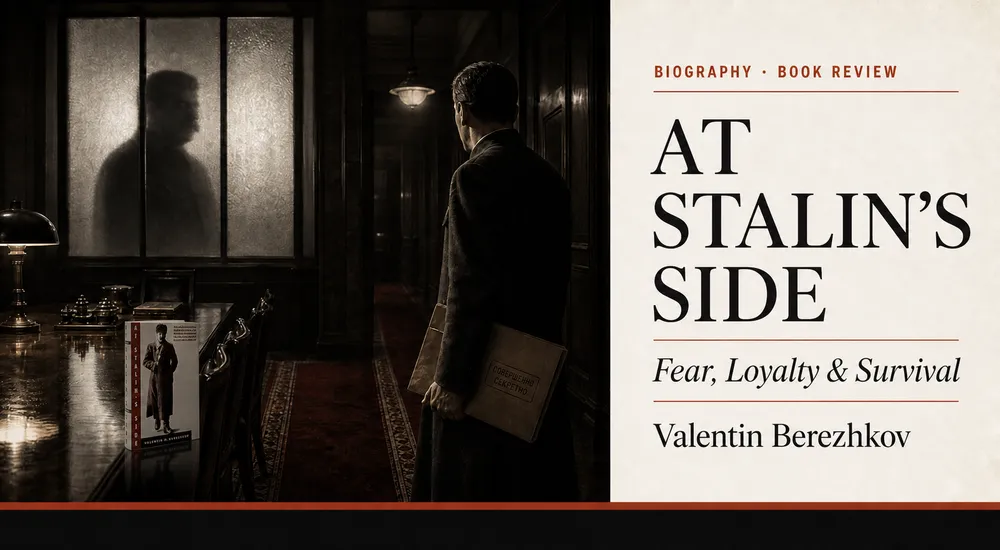
Valentin Berezhkov: An Interpreter Inside Stalin’s Inner Circle
Although Valentin Berezhkov was not Stalin’s primary interpreter, he did attend numerous important meetings with Stalin during the Second World War, including Yalta and in Moscow. With a natural flair for languages, Berezhkov found that he was chosen for important work by Molotov, the number two man in the country, and was suddenly thrust into the middle of history-making events. His memoirs are interesting as they reflect the mindset of suspicion, fear, and ambition at the very highest levels of Soviet government. The leaders of the state were constantly looking over their shoulders and evaluating the ground beneath their feet as their leader, Stalin, the consummate politician and absolute ruler, watched them for any inkling of disloyalty or lack of duty.
The Need to Show Absolute Loyalty
Those same leaders had to submit to the grossest demands, as when, for example, Molotov’s wife, Paulina, was arrested and sent to the Gulag. When Molotov went to Stalin for help, Stalin pointed out that all of his own relatives were also in prison. In fact, almost all the relatives of Stalin’s first and second wives were either in prison or had been shot. The same was true for the wife of the Soviet President, Kalinin, and Stalin’s main assistant, Poskrebyshev. To add salt to the wound for Molotov, Beria, the feared head of the Soviet secret police, would whisper to Molotov from time to time, “Paulina is still alive….” Living in such an atmosphere was obviously stressful, and the stress increased when Beria suggested, during the Second World War, that Berezhkov’s parents might still be alive in Kiev, which had been overrun by the Nazis. Anyone living in such an area was automatically under suspicion of being a collaborator, and thus Berezhkov, being so close to Stalin, could be seen as a threat.
Survival Under Stalin
Fortunately for Berezhkov, Stalin never uttered those dreaded words, “he knows too much,” in his direction. Thus, he was spared arrest and a visit to the Gulag, or death via a car accident, one of the favorite methods of disposing of potential threats, real or imagined. Allowed to take other jobs, he survived the era of Stalin and ended up as a senior researcher at the Institute of USA and Canada Studies of the Russian Academy of Sciences. He also taught courses on political science at Claremont College and at the Monterey Institute of International Studies prior to his death in the late 1990s.
Opinion: A Personal Reckoning with the Communist Ideal
This is a fine book which traces Berezhkov’s early life and belief in the Communist ideal through to his awakening about the reality of the Soviet state. We see through his eyes the hopes and dreams of a better life, and the realization of the terrible cost hundreds of millions paid for their participation in the Communist experiment. In the end, the problem was not Stalin alone, but rather a system which claimed to be based on “science,” which allowed men like Stalin, Beria, and others to rise to the top of the state machinery. At Stalin’s Side remains a valuable memoir for anyone seeking to understand the human cost of Soviet power.