

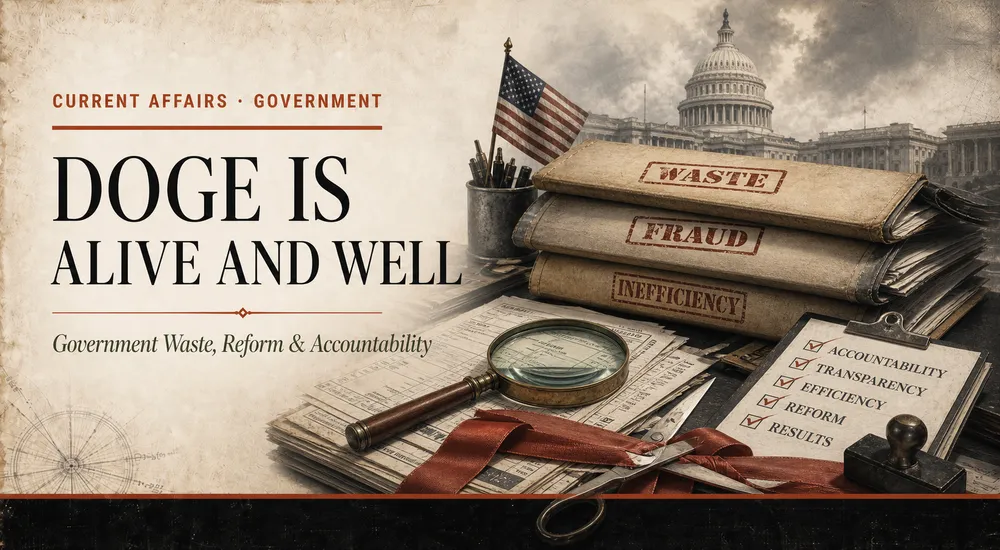
The debate over government spending, waste, fraud, and efficiency continues to attract significant public attention. The Department of Government Efficiency, commonly known as DOGE, has become a prominent part of that discussion, with supporters arguing that greater scrutiny of government spending can uncover waste and improve accountability.
The original commentary argues that DOGE remains active and continues examining government spending despite criticism from political opponents, media organizations, and parts of the federal bureaucracy.
At the heart of the debate is a broader question: How effectively does government manage taxpayer money?
What Is DOGE?
DOGE, or the Department of Government Efficiency, was established as an initiative focused on identifying opportunities to reduce government spending, improve efficiency, and examine federal operations.
Supporters view the effort as an important attempt to identify unnecessary spending and improve the way federal agencies operate.
Critics, meanwhile, have questioned DOGE’s methods, authority, findings, and impact on government programs.
These disagreements reflect a larger political debate about the appropriate size and role of the federal government.
The Debate Over Government Waste
Government waste is not necessarily limited to one political party, administration, or level of government.
Federal agencies manage enormous budgets involving thousands of programs, contracts, grants, and administrative operations. With such a large system, questions about duplication, inefficiency, improper payments, and ineffective programs are inevitable.
The same principle applies beyond Washington. State and local governments also manage substantial amounts of taxpayer money and can face similar challenges involving spending, procurement, administration, and public programs.
Fraud and Accountability in Government
Fraud is another major concern whenever public funds are involved.
Taxpayer money can be vulnerable to improper payments, fraudulent claims, conflicts of interest, or inadequate oversight. Detecting and preventing these problems requires effective auditing, internal controls, transparency, and independent oversight.
Organizations attempting to identify waste or fraud can also face institutional resistance, particularly when proposed reforms affect established programs, procedures, or government employees.
That makes accountability an important part of responsible public administration.
Why Government Efficiency Matters
Improving government efficiency does not necessarily mean eliminating government programs.
Efficiency can also involve reducing unnecessary administrative costs, improving procurement, eliminating duplication, strengthening oversight, and ensuring that public funds are being used for their intended purposes.
When government spends money more efficiently, the potential benefits can include better services without requiring proportionally higher taxes or additional borrowing.
For taxpayers, the issue ultimately comes down to whether government is receiving sufficient value for the money it spends.
Does Government Waste Exist at Every Level?
Government waste is not exclusively a federal issue.
State governments, municipalities, school districts, and other public entities also manage taxpayer-funded budgets. International organizations and foreign governments face similar questions about spending efficiency and financial oversight.
This broader perspective is important because improving public spending requires attention at every level.
Before approving a new bond issue, tax increase, or government spending proposal, citizens can reasonably ask how existing funds are being used and whether current programs are operating efficiently.
The Political Debate Over DOGE
DOGE has become part of a much larger political argument about government size, federal spending, taxation, regulation, and administrative reform.
Supporters argue that aggressive scrutiny is necessary to identify waste and reduce unnecessary spending.
Opponents question some of DOGE’s findings and methods and argue that government programs can provide important public benefits that should not be evaluated solely through cost-cutting measures.
Both perspectives highlight an important principle: government efficiency requires balancing fiscal responsibility with the effective delivery of legitimate public services.
Why Taxpayer Oversight Matters
Ultimately, government spending is funded by taxpayers, whether through income taxes, sales taxes, property taxes, fees, borrowing, or other sources of public revenue.
Citizens therefore have an interest in understanding how governments spend those resources.
Before supporting additional taxes or public borrowing, voters can examine existing budgets, government audits, spending reports, bond proposals, and independent assessments.
The broader DOGE debate reinforces a basic question that applies to every level of government:
Are taxpayers receiving sufficient value for the money being spent?
Frequently Asked Questions
What is DOGE?
DOGE refers to the Department of Government Efficiency, an initiative focused on examining federal government operations, spending, and opportunities for greater efficiency.
What is the purpose of DOGE?
Its stated purpose is to identify opportunities to reduce waste, improve government efficiency, and examine how federal resources are being used.
Does government waste only occur at the federal level?
No. Waste, inefficient spending, and inadequate oversight can occur at federal, state, and local levels of government.
Why is government spending efficiency important?
Efficient spending can help governments provide services while minimizing unnecessary costs and making better use of taxpayer-funded resources.
How can citizens monitor government spending?
Citizens can review public budgets, government audits, spending databases, bond proposals, financial reports, and other publicly available government records.
Why is DOGE controversial?
DOGE has become controversial because its approach to government reform, spending reductions, agency operations, and specific findings has generated significant political disagreement.
What is the larger issue behind the DOGE debate?
Beyond DOGE itself, the debate concerns how governments should manage taxpayer money, control spending, reduce waste, improve accountability, and determine which public programs provide sufficient value.