
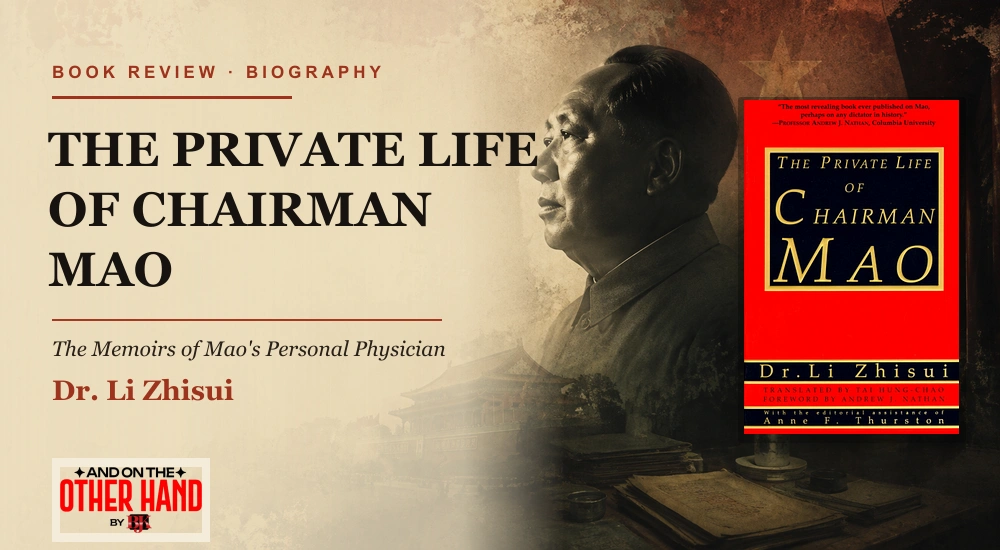
How does a man responsible for the deaths of thirty to forty-five million of his own people actually live from day to day? The 2005 biography of Mao by Jung Chang and Jon Halliday opened many Western eyes to the real Mao, the Mandarin figure carried on a litter during the Long March, the debauched lecher who surrounded himself with young girls, and the ruler who drew his inspiration from the worst emperors in Chinese history, men who wasted the lives of millions without a second thought. This memoir, written by Mao’s own personal physician, adds another layer to the man behind the propaganda posters: the master politician who could wait years to exact his revenge, and the man who, in the end, believed his own myth.
Comfort First: Inside Mao’s Guarded Compounds
For twenty-two years, Dr. Li Zhisui lived largely apart from his own family, confined to the heavily guarded compounds where Mao led a life of considerable indulgence. Aside from his own security, nothing concerned Mao so much as his comfort. Using state funds, he ordered a luxury personal train built in East Germany, had swimming pools constructed at his various villas, and, to guarantee his comfort even while traveling, brought along his own hard wooden bed and insisted on a squat-style privy, even on visits to Moscow.
Life as Mao’s Personal Physician
Being Mao’s personal physician was neither an easy job nor a safe one. The son of a former Kuomintang general, married to a woman whose father had been a large landowner (she had also worked with the British and Americans during the war), and educated in the West, Dr. Li returned to China after the revolution believing he could help build a modern state. Instead, his skills were set aside in service of one man. With no political base of his own and none of the instincts required to survive Communist Party politics, he remained an outsider under permanent suspicion. Mao himself was healthy in his early years but kept poor hygiene; he refused to brush his teeth, gargling instead with green tea, which left his teeth stained green and his breath foul. Beyond a fondness for swimming, he took little exercise, and in time this caught up with him in the form of several medical conditions.
Comfort for the Inner Circle, Puritanism for the Masses
Over the years, Dr. Li grew increasingly disillusioned as he watched Mao’s inner circle live in comfort few ordinary citizens could imagine: the best food from private farms, casual corruption, Western goods worn as badges of status, while the needs of the masses went ignored. He watched Mao lounge by his pools for hours, take up with whichever young woman on his staff had most recently caught his eye, all while sexual puritanism was preached to the country at large, and all while Mao quietly plotted his long-term revenge against those around him.
Witness to the Great Leap Forward Famine
He also witnessed firsthand the hardship and famine that followed directly from the Great Leap Forward. Mao had convinced himself that China could overtake Great Britain within a few years, and one measure of that ambition was turning China into a major steel producer. Rather than buy steel mills from the West, partly for lack of capital, millions of peasant households were ordered to build small backyard furnaces instead. There was no coal to fuel them, so peasants cut down millions of trees for fuel. The furnaces needed constant feeding day and night, which pulled peasants away from their fields, leaving crops untended and much of the harvest lost. When even the raw materials for steel ran short, teams went door to door collecting anything made of metal: pans, doorknobs, pots, knives, forks, whatever could be melted down. The result was that people no longer had the tools to cook their own food, went hungry, and in some cases tried to survive by eating dirt, all to produce useless lumps of metal. Mao saw none of it. His own meals were always ready and on time.
How Much Did Dr. Li Really Know?
It is fair to be a little skeptical of how the doctor portrays himself here. He insists he never truly grasped the human and moral cost of the Great Leap Forward, the Cultural Revolution, and the rest. In a country where thirty to forty-five million people starved to death, while Mao and his entourage moved about in private planes and rail cars, how plausible is it that he remained unaware of a catastrophe unfolding on that scale? And yet, even granting that he knew, what exactly could he have done? Nothing, probably, since Mao himself believed the people needed to suffer in order to tear down the old order. During the Cultural Revolution, the author was not spared either; he was sent to be “re-educated” in the countryside like so many others.
Verdict: A Fine Companion to the Chang and Halliday Biography
This book makes a fine companion to the earlier biography. It helps explain the rise of the Gang of Four and offers a rare, close-up view of what absolute power actually corrupts, and who pays the price for it.
Frequently Asked Questions About The Private Life of Chairman Mao
Who wrote The Private Life of Chairman Mao?
Dr. Li Zhisui, who served as Mao Zedong’s personal physician for twenty-two years and lived inside his heavily guarded compounds, largely apart from his own family. The memoir was first published in 1994.
What does The Private Life of Chairman Mao reveal about Mao’s daily life?
It shows a ruler who cared about little beyond his own security and comfort: a luxury train built in East Germany, swimming pools at his villas, his own wooden bed and squat-style privy carried on every trip, poor hygiene, and a succession of young women from his staff, all while sexual puritanism was preached to the country at large.
Does the book cover the Great Leap Forward famine?
Yes. Dr. Li witnessed the backyard-furnace campaign firsthand: peasants pulled from their fields to feed the furnaces, forests cut down for fuel, and household pots and tools melted into useless lumps of metal while the harvest was lost. He describes the hunger that followed and notes that Mao’s own meals were always ready and on time.
Is Dr. Li Zhisui a reliable narrator?
His firsthand detail is hard to dismiss, but one claim deserves some skepticism: that he never truly grasped the human cost of the Great Leap Forward and the Cultural Revolution while living at the center of power. Even so, he paid a price of his own, and was sent to the countryside for “re-education” during the Cultural Revolution.
How does it compare to Mao: The Unknown Story by Jung Chang and Jon Halliday?
The two books work best together. Chang and Halliday’s 2005 biography gives the full sweep of Mao’s life and crimes; The Private Life of Chairman Mao gives the close-up view of the man, his inner circle, and the rise of the Gang of Four. If you have read one, the other is worth your time.