
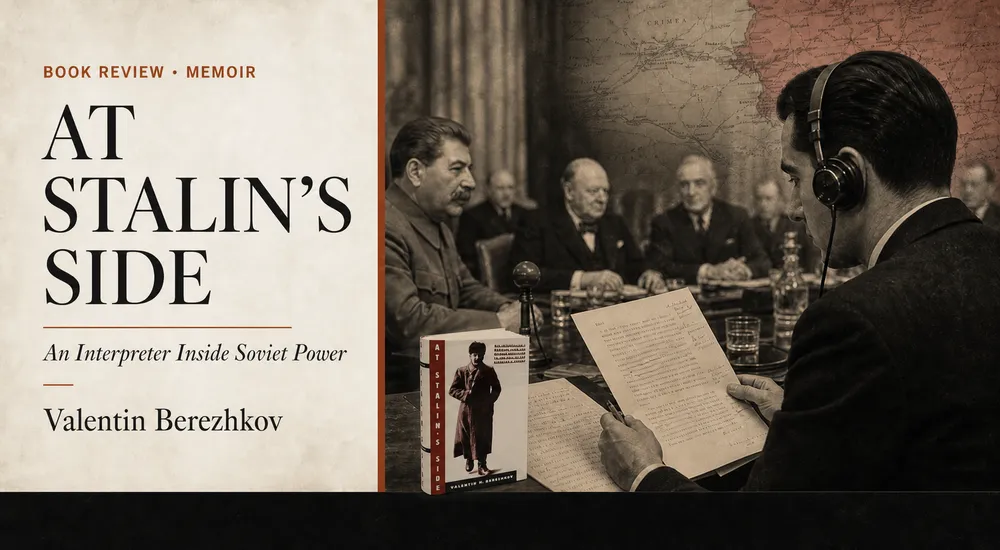
At Stalin’s Side: His Interpreter’s Memoirs by Valentin Berezhkov
Although Valentin Berezhkov was not Stalin’s primary interpreter, he attended numerous important meetings with Stalin during the Second World War, including the Yalta Conference and talks in Moscow. With a natural flair for languages, Berezhkov was selected for important work by Vyacheslav Molotov, one of the most powerful figures in the Soviet government, and was suddenly thrust into the middle of history-making events.
His memoirs, which span the period from the October Revolution through the later years of Stalin’s rule, are valuable because they capture the atmosphere of suspicion, fear, and ambition at the highest levels of Soviet government. Leaders were constantly watching their surroundings and carefully demonstrating their loyalty, while Stalin closely monitored them for any sign of disloyalty or failure to fulfill their duties.
The Need to Show Absolute Loyalty
Those same leaders had to submit to extraordinary political demands. Molotov’s wife, Polina, was arrested and sent to the Gulag. When Molotov appealed to Stalin for help, Stalin pointed out that members of his own family were also imprisoned.
The families of other prominent Soviet officials experienced similar persecution. Relatives of Stalin’s first and second wives were imprisoned or executed, while the wife of Soviet President Mikhail Kalinin and members of Stalin’s inner circle also faced repression.
Lavrentiy Beria, the feared head of the Soviet secret police, would reportedly remind Molotov from time to time that Polina was still alive. Such incidents demonstrate how personal relationships and family members could become tools of political pressure within Stalin’s government.
Living in this atmosphere was extremely stressful. The pressure increased when Beria suggested during the Second World War that Berezhkov’s parents might still be alive in Nazi-occupied Kiev. People connected with occupied territories could automatically become objects of suspicion because of possible collaboration with the enemy. As someone working close to Stalin, Berezhkov could therefore have been viewed as a potential threat.
Survival in Stalin’s Inner Circle
Fortunately for Berezhkov, he avoided the fate that befell many people who became targets of Stalin’s political system. He escaped arrest, imprisonment in the Gulag, and other dangers that threatened officials and individuals considered politically unreliable.
Eventually allowed to pursue other professional work, Berezhkov survived the Stalin years and became a senior researcher at the Institute of USA and Canada Studies of the Russian Academy of Sciences.
He later taught political science at Claremont College and the Monterey Institute of International Studies. His career continued well beyond the Stalin era, and he remained connected to political and historical scholarship until his death in the late 1990s.
Opinion: Is At Stalin’s Side Worth Reading?
At Stalin’s Side is a valuable historical memoir that traces Berezhkov’s early life, his belief in Communist ideals, and his eventual understanding of the realities of the Soviet state.
Through Berezhkov’s experiences, readers encounter the hopes associated with the Communist experiment alongside the devastating human consequences of the political system that developed under Stalin.
The memoir is especially interesting because it does not simply focus on Stalin as an individual. It also examines the broader political system that allowed powerful figures such as Stalin and Beria to rise to the highest levels of government.
For readers interested in Soviet history, Stalin’s inner circle, political memoirs, World War II diplomacy, and historical biographies, At Stalin’s Side by Valentin Berezhkov provides a revealing perspective on one of the most significant periods of the twentieth century.
Frequently Asked Questions
Who wrote At Stalin’s Side?
At Stalin’s Side: His Interpreter’s Memoirs was written by Valentin Berezhkov, a Soviet interpreter and researcher who worked around senior Soviet officials and participated in important wartime meetings.
What is At Stalin’s Side about?
The memoir describes Berezhkov’s experiences within the Soviet government and his encounters with Stalin and other senior officials. It explores the atmosphere of fear, suspicion, loyalty, and political pressure surrounding Stalin’s leadership.
Was Valentin Berezhkov Stalin’s primary interpreter?
No. Berezhkov was not Stalin’s primary interpreter, but he attended numerous important meetings involving Stalin and other senior Soviet officials, including wartime diplomatic discussions.
Why is At Stalin’s Side historically significant?
The book provides a personal perspective on Soviet political life during Stalin’s rule. It offers insight into the experiences of officials working close to the highest levels of the Soviet government.
Is At Stalin’s Side worth reading?
Yes. The memoir is particularly worthwhile for readers interested in Stalin, Soviet history, World War II diplomacy, political biographies, and firsthand accounts of life within an authoritarian political system.
What topics does At Stalin’s Side cover?
The memoir covers Berezhkov’s early life, his work as an interpreter, Soviet political leadership, Stalin’s inner circle, wartime diplomacy, Communist ideology, political repression, and his changing understanding of the Soviet state.