
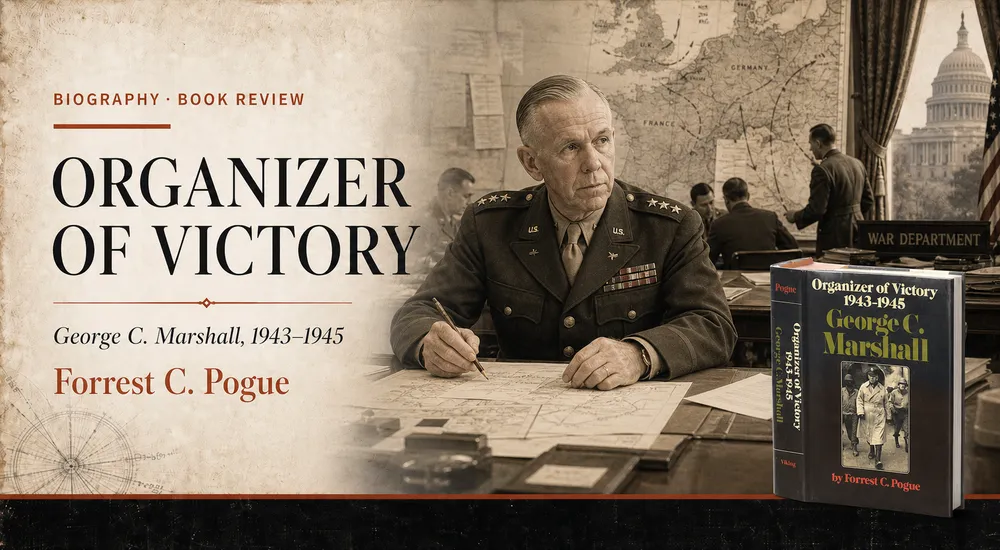
Forrest C. Pogue’s Organizer of Victory, 1943–1945 is the third volume of his extensive biography of George C. Marshall. The book examines Marshall’s leadership during some of the most critical years of the Second World War and provides a detailed look at how he helped transform the United States military into a force capable of fighting a global war.
Marshall’s leadership can be compared with the classical ideal represented by Lucius Quinctius Cincinnatus: a leader who accepts responsibility during a national crisis, serves his country, and does not seek personal wealth or permanent political power afterward.
Pogue’s biography presents Marshall as a disciplined and highly principled military leader who placed duty, military effectiveness, and the interests of American soldiers above personal relationships or political considerations.
George C. Marshall as a Modern Cincinnatus
For more than two thousand years, Lucius Quinctius Cincinnatus has represented ideals of military leadership, civic responsibility, service to the state, and the willingness to walk away from power after completing one’s duty.
George Washington has often been described as an American example of this tradition. After reading Pogue’s biography, Marshall can similarly be viewed as a modern Cincinnatus.
Marshall was offered foreign honors, public recognition, and substantial financial opportunities. In 1947, he reportedly declined an offer of at least $1 million for his memoirs, a figure that would be worth considerably more today.
Instead of pursuing personal wealth or celebrity, Marshall focused on his responsibilities as the senior military leader guiding the United States through the Second World War.
Marshall’s Leadership During World War II
One of the greatest challenges facing Marshall was the rapid expansion of the American military.
Under his leadership, the United States Army grew from fewer than 200,000 personnel to nearly 9 million in just over two years. This required an enormous effort to mobilize, equip, train, and organize military forces while identifying officers capable of leading them through modern warfare.
Marshall also had to work with President Franklin D. Roosevelt, Congress, other branches of the armed services, and major Allied leaders including Winston Churchill and Charles de Gaulle.
The political and military pressures were immense, but Marshall maintained a strong sense of duty and attempted to keep military decision-making above partisan politics.
Loyalty, Merit, and Military Leadership
Marshall demonstrated a strong commitment to professional military standards. While he could be extremely demanding with career officers who were unable to adapt to modern warfare, he also showed significant concern for the morale and well-being of ordinary soldiers.
He was particularly resistant to favoritism. When former friends or fellow officers approached him seeking special treatment, Marshall generally refused to intervene unless the request involved accepting a more dangerous assignment.
His reasoning was rooted in experience. He understood that favoritism could place unqualified individuals in positions of responsibility and ultimately put soldiers’ lives at unnecessary risk.
For Marshall, military leadership required selecting officers based on ability rather than personal connections.
Marshall’s Vision for Air Power
Pogue also highlights Marshall’s understanding of the importance of air power in modern warfare.
During the Second World War, the air arm remained part of the Army rather than functioning as a completely independent military service. The United States Air Force would not become a separate branch until after the war.
Marshall recognized the strategic importance of controlling the air and supported military leaders who understood how air power could influence modern warfare. Officers who failed to adapt to this changing reality could find themselves removed from important positions.
His willingness to make difficult personnel decisions demonstrates the broader theme of Pogue’s biography: Marshall prioritized military effectiveness over personal loyalty.
Marshall After World War II
After the war, Marshall sought a quieter life rather than using his position to accumulate personal wealth or political influence.
However, his public service did not end permanently. He was later called upon to serve in China, undertaking a difficult mission that ultimately proved unsuccessful.
Marshall also became closely associated with the Marshall Plan, the major American program designed to support the economic recovery of Western Europe after the devastation of the Second World War.
The program helped rebuild European economies while also strengthening the political and economic stability of Western Europe at a time when Soviet influence was expanding.
Is Organizer of Victory, 1943–1945 Worth Reading?
Organizer of Victory, 1943–1945 by Forrest C. Pogue is a detailed and demanding biography, particularly for readers who are not already familiar with the political and military circumstances of the Second World War.
The amount of historical detail can make the book challenging, but that same detail is one of its greatest strengths. Pogue’s research provides a deeper understanding of Marshall, a notably private individual whose decisions had enormous consequences.
For readers interested in George C. Marshall, World War II leadership, American military history, military strategy, and political history, this volume offers a valuable examination of one of the most important American military leaders of the twentieth century.
The book is especially worthwhile for readers seeking to understand Marshall not simply as a military commander, but as a leader who placed duty, merit, discipline, and national service above personal advancement.
Frequently Asked Questions
What is Organizer of Victory, 1943–1945 about?
Organizer of Victory, 1943–1945 is the third volume of Forrest C. Pogue’s biography of George C. Marshall. It focuses on Marshall’s leadership during the critical years of World War II.
Who wrote Organizer of Victory, 1943–1945?
The book was written by historian Forrest C. Pogue as part of his multi-volume biography of George C. Marshall.
What role did George C. Marshall play in World War II?
Marshall served as a leading figure in the organization and expansion of the U.S. Army during World War II. He helped oversee the transformation of the American military from a relatively small peacetime force into a massive wartime organization.
Why is George C. Marshall compared to Cincinnatus?
Marshall is compared to Cincinnatus because of his emphasis on duty and public service and his reluctance to pursue personal wealth, political power, or public honors after serving his country.
What does the book say about Marshall’s leadership style?
The biography presents Marshall as disciplined, demanding, merit-focused, and resistant to favoritism. He prioritized military effectiveness and the welfare of soldiers over personal relationships.
Is Organizer of Victory, 1943–1945 difficult to read?
The book can be challenging because of its extensive historical detail and its discussion of military and political events. Readers familiar with World War II history may find it easier to follow, while newcomers may need additional historical context.
Is Organizer of Victory, 1943–1945 worth reading?
Yes. It is particularly recommended for readers interested in George C. Marshall, World War II, American military leadership, military history, and the development of modern U.S. military strategy.