

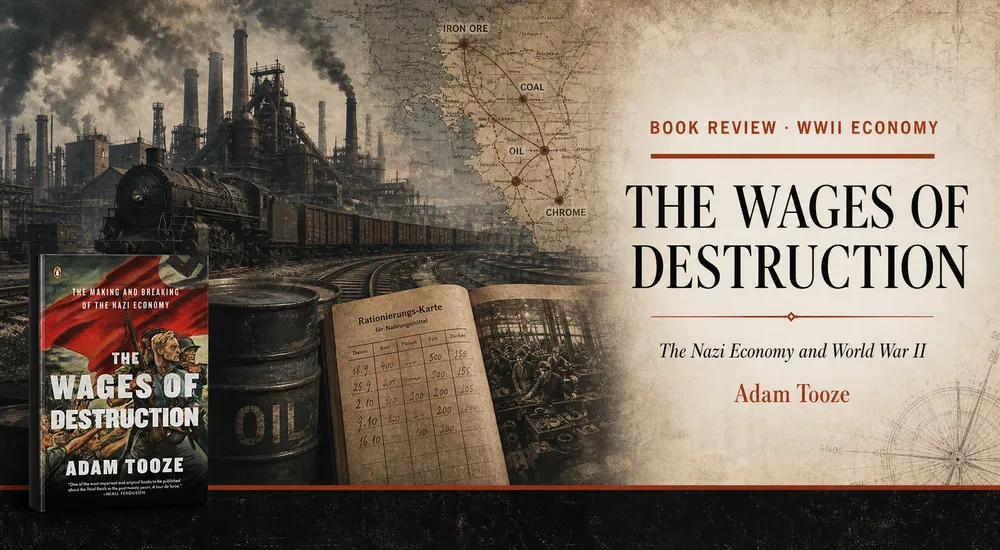
Adam Tooze’s Wages of Destruction: The Making and Breaking of the Nazi Economy examines an often-overlooked dimension of Nazi Germany’s rise and its conduct of the Second World War: the relationship between economics, military strategy, resources, and foreign policy.
Many histories of Nazi Germany focus primarily on military campaigns, political developments, ideology, and mobilization. Tooze’s work adds another perspective by examining how Germany’s economic limitations influenced strategic decisions and helped shape the course of the war.
The book explores issues including raw materials, agricultural production, foreign exchange reserves, oil supplies, industrial capacity, and Germany’s ability to sustain a prolonged conflict against larger economic powers.
The Economic Limitations of Nazi Germany
A central theme of Wages of Destruction by Adam Tooze is that Germany faced significant economic and resource limitations when compared with potential long-term adversaries such as the Soviet Union, the British Empire, and the United States.
Germany did not possess the same combination of population, territory, agricultural resources, raw materials, and industrial capacity available to its major opponents.
These limitations made the question of time extremely important. A prolonged war of attrition could place Germany at a serious disadvantage as its opponents mobilized greater economic and industrial resources.
Tooze’s analysis therefore connects economic realities with the strategic decisions made by Nazi Germany during the years leading up to and during World War II.
Why Germany Sought Short Wars
Germany’s economic position helps explain the importance placed on rapid military victories.
Following the defeat of Poland in 1939, Hitler pushed for preparations for an offensive against Western Europe. German military leaders had serious concerns about such a campaign because Britain and France represented considerably more formidable opponents than Poland.
There were also practical military concerns involving weather, air power, defensive strategy, and the possibility of repeating the prolonged conflict of the First World War.
From an economic perspective, however, remaining on the defensive presented its own risks. Britain was rearming, the United States was supplying military equipment to the Allies, and Germany faced important limitations in areas such as oil.
These pressures made a rapid victory particularly attractive to German planners.
The Sickle Plan and the Western Campaign
The Western campaign also illustrates the relationship between military strategy and economic considerations.
Earlier German planning had contemplated an approach influenced by the Schlieffen Plan of the First World War. Such a strategy risked producing another prolonged conflict in which Germany would have to compete against stronger economic and industrial powers.
The alternative associated with the Sickle Plan offered the possibility of a faster and more decisive campaign.
Tooze’s broader argument helps readers understand why military strategy cannot always be separated from economic realities. The ability to sustain fuel supplies, industrial production, transportation, and military equipment can fundamentally shape the options available to a nation at war.
Economic Resources and the Invasion of the Soviet Union
The invasion of the Soviet Union represents another major example of the connection between economics and military strategy.
The Nazi invasion was driven by multiple ideological, political, strategic, and economic objectives. Among the economic considerations were Germany’s need for access to agricultural products, minerals, and oil.
The Soviet Union possessed enormous quantities of natural resources that Germany lacked or could not produce in sufficient quantities domestically.
The war in the East was therefore connected not only to Nazi ideological goals and racial policies but also to Germany’s broader struggle over resources and economic security.
Why Wages of Destruction Is Worth Reading
Wages of Destruction by Adam Tooze provides a valuable economic perspective on Nazi Germany and World War II.
The book encourages readers to look beyond battlefield movements and political decisions and consider the underlying economic forces that shaped German strategy.
For students and serious readers of Nazi Germany, the book offers an opportunity to reconsider how resource shortages, industrial capacity, energy requirements, agricultural production, and international economic competition influenced German decision-making.
Its greatest strength is the way it connects economic history with military and political history. Readers who already have a strong understanding of the period may find that Tooze’s analysis adds an important dimension to their understanding of Nazi Germany.
Frequently Asked Questions
What is Wages of Destruction by Adam Tooze about?
Wages of Destruction examines the economic history of Nazi Germany and explains how resources, industrial capacity, foreign exchange, agriculture, energy, and economic limitations influenced German political and military decisions.
Why is economics important to understanding Nazi Germany?
Economic resources influenced Germany’s ability to produce weapons, obtain fuel, feed its population, and sustain military campaigns. Understanding these limitations can provide additional context for German strategic decisions.
Why did Germany seek rapid military victories?
Germany faced significant economic and resource limitations compared with several of its major opponents. A prolonged war of attrition could therefore create increasingly difficult conditions for the German war effort.
How did resources influence the invasion of the Soviet Union?
The Soviet Union possessed substantial supplies of oil, grain, minerals, and other resources. Access to these resources formed an important part of the economic and strategic considerations surrounding Germany’s war in the East.
Does Wages of Destruction focus only on military history?
No. The book primarily examines economic history but connects economic conditions with military strategy, foreign policy, industrial production, resource acquisition, and the broader development of Nazi Germany.
Is Wages of Destruction worth reading?
Yes. It is particularly valuable for readers and students interested in Nazi Germany, World War II, economic history, military strategy, and the relationship between national resources and wartime decision-making.