
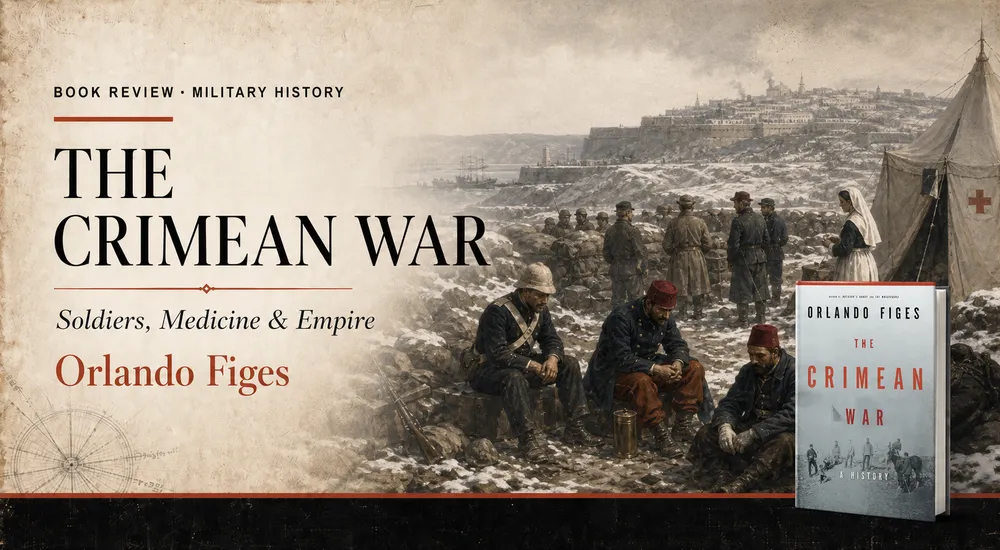
One of the strengths of Orlando Figes’s historical writing is its readability. In The Crimean War, Figes brings the nineteenth-century conflict to life by focusing not only on military campaigns and battles but also on the experiences of ordinary soldiers.
Like his other historical works, Figes combines political and military history with personal stories, helping readers understand what the war was like for the people who actually experienced it.
The result is a substantial but accessible history that explores the Crimean War, military medicine, the experiences of soldiers, and the broader geopolitical consequences of the conflict.
The Crimean War Through the Experiences of Soldiers
Rather than concentrating exclusively on commanders and battlefield strategies, Figes gives considerable attention to ordinary soldiers.
Their experiences reveal the practical realities of nineteenth-century warfare, including inadequate supplies, harsh weather, disease, difficult living conditions, and the physical and psychological effects of prolonged combat.
This approach makes the history more personal. Instead of viewing the Crimean War only through maps and military campaigns, readers gain a better understanding of how the conflict affected the people serving on the front lines.
Florence Nightingale and Advances in Military Medicine
The Crimean War is often strongly associated with Florence Nightingale and her work in military hospitals.
Figes gives comparatively less attention to Nightingale while highlighting the important contributions of Russian surgeon Dr. Nikolai Pirogov. Pirogov helped introduce more systematic medical practices, including an early form of triage and the use of anesthesia.
These developments demonstrate how wartime conditions could accelerate changes in medical treatment and battlefield care.
The history of military medicine is an important part of understanding the Crimean War because disease, injuries, and inadequate medical support contributed significantly to the suffering experienced by soldiers.
French and British Contributions to the War
The conventional image of the Crimean War often emphasizes Britain’s role, but Figes provides a broader picture of the Allied effort.
The French supplied a substantial proportion of the coalition’s troops and, according to the book’s account, generally provided their soldiers with better supplies than the British.
This included essential equipment and provisions such as tents, food, and warm clothing needed to endure the severe Crimean winter.
The comparison highlights how logistics and military supply could be just as important as battlefield courage. An army’s ability to feed, clothe, house, and equip its soldiers could directly affect its effectiveness.
Plans to Break Up the Russian Empire
Another fascinating element of The Crimean War by Orlando Figes is the discussion of broader strategic plans involving Russia.
The Allied coalition considered ambitious possibilities that extended beyond the immediate fighting in Crimea. These included potential operations in the Baltic, uprisings in Poland, and an invasion toward Kiev.
However, as casualties increased and the costs of the conflict became more apparent, enthusiasm for such expansive plans declined.
Eventually, the competing powers moved toward a negotiated settlement rather than attempting to pursue the most ambitious possibilities for weakening the Russian Empire.
The Long-Term Consequences of the Crimean War
The Crimean War had consequences that extended well beyond the peace settlement.
Although Russia suffered significant losses and political setbacks, it eventually regained much of its international position. Russian influence and ambitions in the Balkans continued to affect European politics for decades.
The broader history of Russian foreign policy would eventually become connected to the tensions that contributed to the outbreak of the First World War.
Figes therefore places the Crimean War within a much larger European story, showing how decisions and political assumptions in the nineteenth century continued to influence international relations long afterward.
Is The Crimean War Worth Reading?
At approximately 500 pages, The Crimean War by Orlando Figes is a substantial historical work, but its length does not prevent it from remaining engaging.
One of the book’s major strengths is its ability to maintain focus on the central historical narrative without becoming overwhelmed by unnecessary tangents.
For readers interested in nineteenth-century European history, military history, Russia, the Ottoman Empire, the British Empire, and the origins of later European conflicts, Figes’s book provides a detailed and accessible introduction to the Crimean War and its wider significance.
Frequently Asked Questions
What is The Crimean War by Orlando Figes about?
The book examines the Crimean War through its military campaigns, political objectives, international alliances, soldiers’ experiences, medical developments, and long-term consequences for Europe.
Does The Crimean War focus on ordinary soldiers?
Yes. One of the book’s strengths is its attention to the experiences of ordinary soldiers rather than focusing exclusively on generals and major battles.
Who was Nikolai Pirogov?
Nikolai Pirogov was a prominent Russian surgeon who contributed to military medicine during the Crimean War. He is associated with the use of early triage methods and anesthesia.
What role did France play in the Crimean War?
France was a major contributor to the Allied war effort and supplied a substantial number of troops. Figes also discusses the effectiveness of French military supply compared with that of the British.
Why was the Crimean War important?
The war affected the balance of power in Europe, exposed weaknesses in military organization and logistics, influenced medical practices, and had lasting consequences for Russian foreign policy and European diplomacy.
Is The Crimean War by Orlando Figes worth reading?
Yes. It is particularly recommended for readers interested in military history, nineteenth-century Europe, Russia, international relations, and the experiences of soldiers during major historical conflicts.